
Italian · Main course · SAMPLE RECIPE
Trofie with pesto, potatoes & green beans
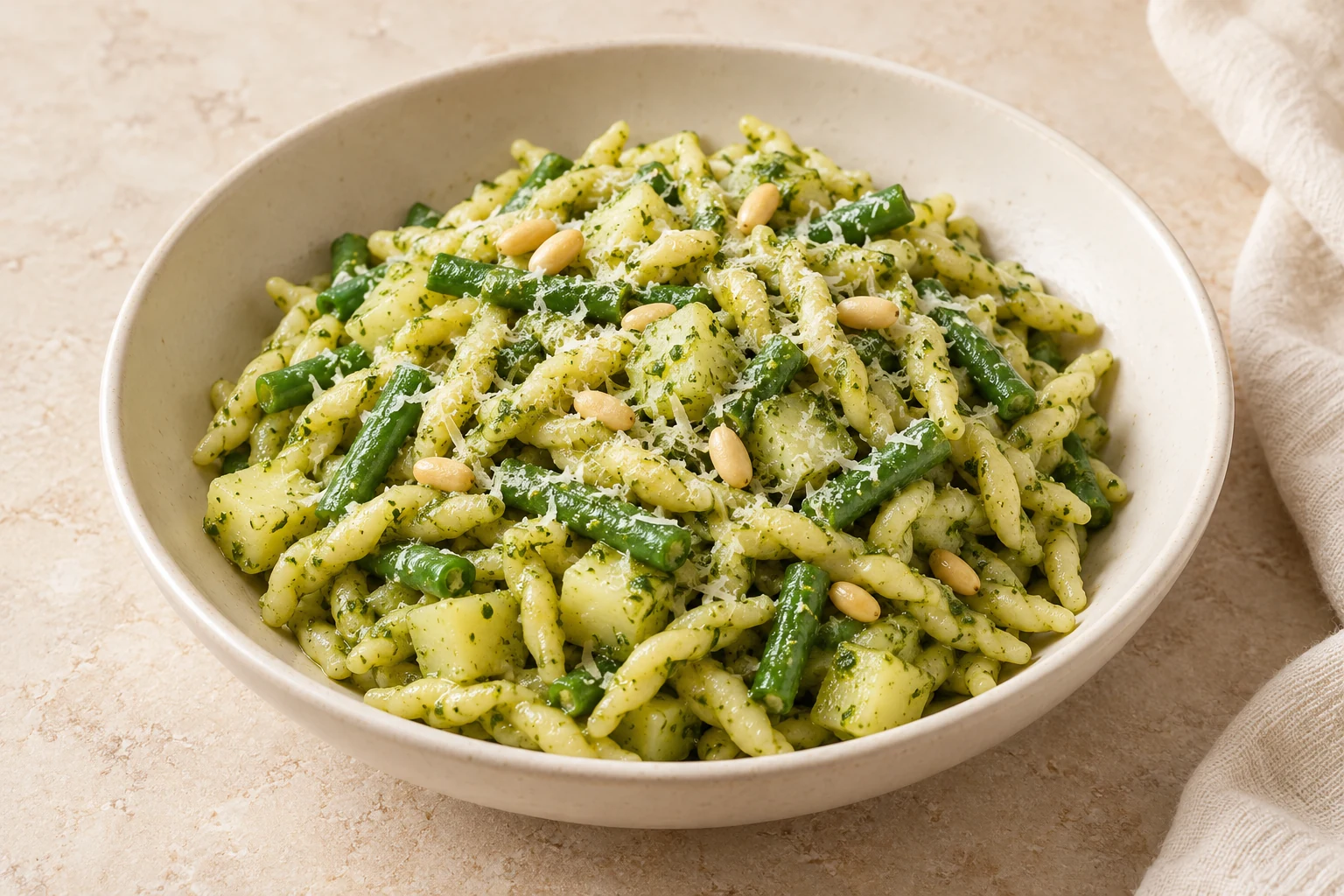
Little twists of pasta catch a fresh basil pesto alongside tender potato cubes and green beans. Parmesan, Pecorino, and pine nuts make a rounded, savory finish.
Save to your Saucey Space, or keep a bookmark on this device.
A NOTE FROM THE KITCHEN
Keep the pesto away from direct heat.
Genoese pesto is traditionally worked in a mortar. This practical version uses short food-processor pulses and store-bought dried trofie. Potatoes and green beans are established companions to pesto pasta; the sauce is folded through after cooking.
Ready to get started? The ingredients and steps are right below.
LET’S MAKE SOMETHING GOOD
Trofie with pesto, potatoes & green beans
Sample recipe awaiting kitchen testing. Timings are estimates.
The good part
Check off each step as you cook.
0 of 4 steps complete
BEHIND THE DISH · Genoa and the eastern Ligurian coast, Italy
Trofie with pesto, potatoes & green beansBeyond the plate.
Trofie and pesto bring together a hand-shaped pasta and a sauce traditionally made by pounding. Their shared Ligurian identity includes coastal villages, domestic work, commercial pasta making, and public celebrations of a skill once practiced mainly at home.
ORIGINS & EVOLUTION
Twisted pasta meets a changing sauce.
Trofie are closely associated with the coast around Sori and Recco. The traditional dough uses flour and water rather than eggs, shaped into little twists. Chestnut-flour versions also belong to the wider local repertoire, reminding us that the shape has more than one expression.
A pesto recipe appears in Giovanni Battista Ratto’s Genoese cookbook of 1863. Its options included herbs and cheeses that differ from today’s familiar basil-and-pine-nut mixture. That printed record documents an evolving sauce, rather than proving that every modern detail has always been fixed.
CULTURAL IMPACT
Household skill takes a public stage.
Pesto now serves as a recognizable emblem of Genoese cooking. Potatoes and green beans are established partners for pesto pasta, not merely modern additions to make a plate look greener. The vegetables and twisted pasta give the same sauce several different textures.
The first world pesto championship in Genoa, held in 2007, brought a hundred competitors to their mortars. Its winner was home cook Luciana Parodi. The event put domestic expertise alongside professional cooking in a public celebration of regional knowledge.
SOCIAL HISTORY
The work behind the little twists.
An account from a pasta producer in Sori describes a mid-twentieth-century network of women making trofie at home. Flour was distributed and finished pasta collected for sale to shops and restaurants. What looked like household work also supplied a commercial market.
Later mechanization changed how those quantities could be produced. Our use of purchased dried trofie and briefly processed pesto belongs to another practical adaptation. It makes the dish accessible at home while acknowledging the hand skills behind its traditional forms.
What else sounds good?
There’s a little more inspiration in the kitchen.
Back to the recipes