
Greek · Main course · SAMPLE RECIPE
Spanakopita
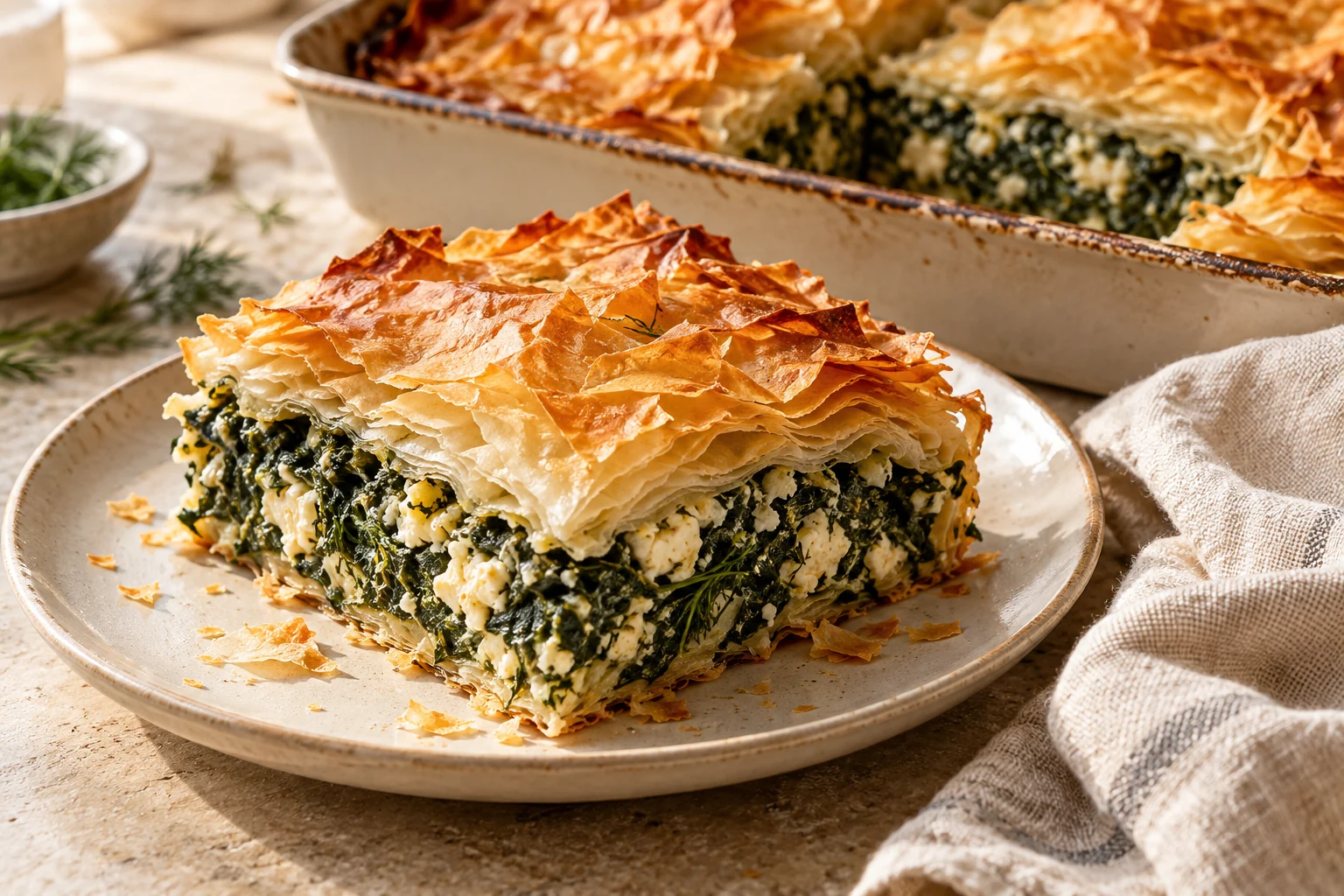
Greece’s spinach-and-feta pie, wrapped in delicate golden phyllo. Crisp edges, a generous green filling, and plenty to share.
Save to your Saucey Space, or keep a bookmark on this device.
A NOTE FROM THE KITCHEN
Dry spinach makes crisp pastry.
Squeeze the thawed spinach firmly in a clean kitchen towel until very little water remains. Too much moisture softens the layers beneath it. Start with fully thawed spinach and phyllo; package thawing time is additional to the times shown.
Ready to get started? The ingredients and steps are right below.
LET’S MAKE SOMETHING GOOD
Spanakopita
Sample recipe awaiting kitchen testing. Timings are estimates.
The good part
Check off each step as you cook.
0 of 4 steps complete
BEHIND THE DISH · Greece
SpanakopitaBeyond the plate.
Spanakopita is one member of Greece’s much larger family of savory pies. Its crisp pastry carries a history of portable meals, seasonal greens, skilled hands, and the cooking exchanged between households and generations.
ORIGINS & EVOLUTION
A spinach pie within a wider tradition.
Greek pita can mean a pie, and the repertoire includes cheese, meat, vegetables, and greens in many shapes. Spanakopita identifies the spinach branch of that family. It is more useful to place it within this continuing practice than to assign today’s spinach-and-feta pie an unverified ancient birth date.
Savory pies are especially associated with mainland regions including Epirus and Thessaly. Food writer Diane Kochilas connects that prominence with shepherd families, who could make portable meals from flour, dairy products, and gathered greens. This is context for the wider pie tradition, not proof that one shepherd invented spanakopita.
CULTURAL IMPACT
One famous pie opens a much larger door.
International familiarity with spinach pie can make the Greek repertoire seem narrower than it is. Pies may be large and sliced, individually shaped, baked, or fried. Regional choices reflect different ingredients and practices; the familiar layered tray is one expression of that variety.
The filling varies too. Some spinach pies contain no cheese, while spinach-and-cheese pies can be called spanakotyropita. Our version includes feta, eggs, scallions, dill, and parsley. Naming the ingredients makes that choice clear without treating it as the only valid Greek preparation.
SOCIAL HISTORY
Pastry reveals the work of the cook.
Rolling thin phyllo has long been a visible measure of skill. Accounts of Greek domestic cooking also describe women helping one another prepare food and exchanging portions afterward. In that setting, kitchen labor could create relationships and occasions for recognition as well as feed a household.
Those histories deserve attention alongside the finished pie: delicate layers require time and practice. Our recipe uses purchased phyllo and frozen spinach, shifting the work toward draining the filling and assembling the layers. The shortcuts change the labor involved while preserving the pleasure of cutting a shared pie at the table.
What else sounds good?
There’s a little more inspiration in the kitchen.
Back to the recipes