
Italian · Main course · SAMPLE RECIPE
Spaghetti cacio e pepe
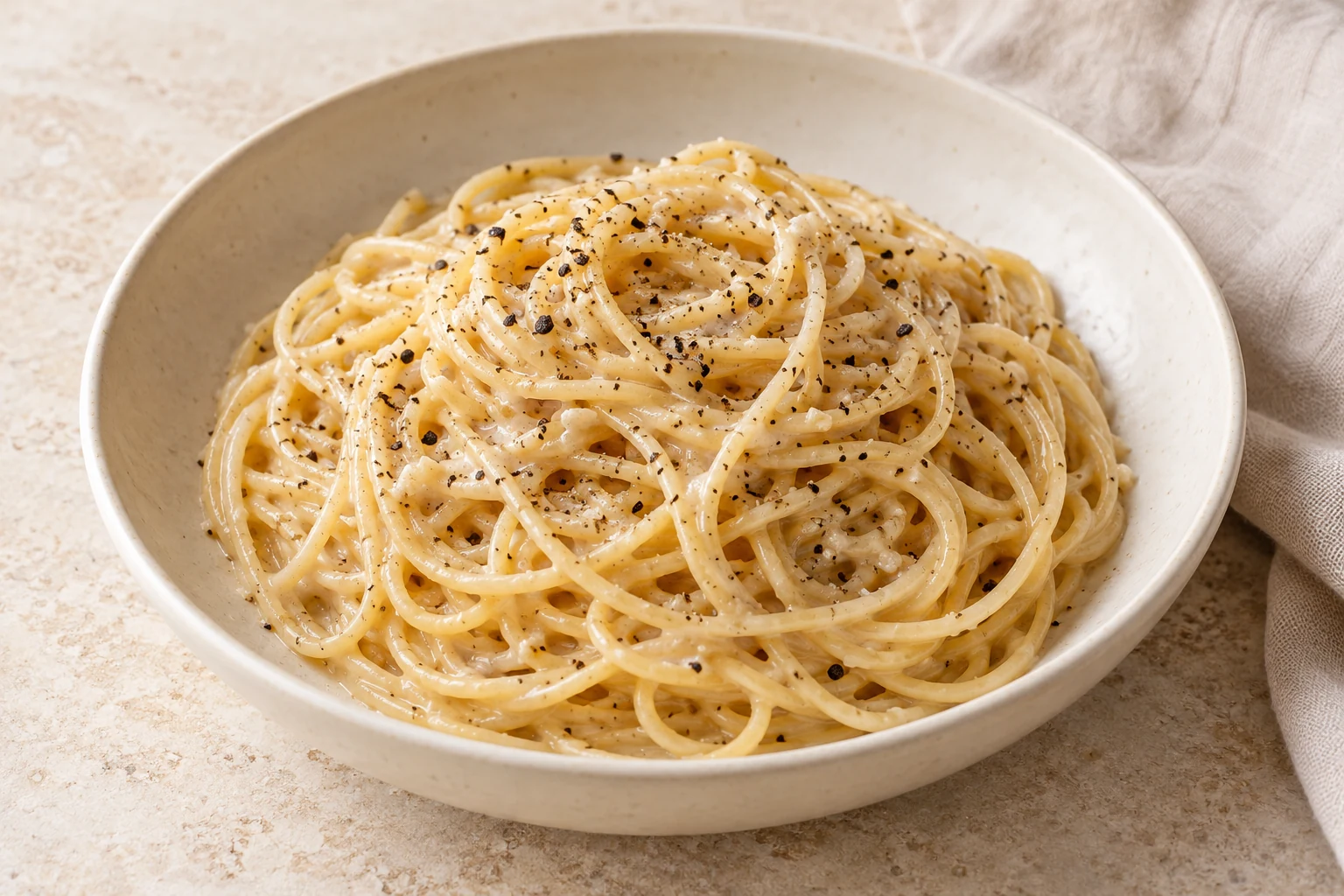
Spaghetti wrapped in a silky Pecorino sauce with the warmth of freshly cracked black pepper. A short ingredient list rewards a little care at the stove.
Save to your Saucey Space, or keep a bookmark on this device.
A NOTE FROM THE KITCHEN
Gentle heat makes the sauce.
This Roman cheese-and-pepper pasta gets its creamy texture from Pecorino and starchy cooking water, without cream. Grate a block of cheese very finely before starting, and take the pan off the heat before bringing the sauce together.
Ready to get started? The ingredients and steps are right below.
LET’S MAKE SOMETHING GOOD
Spaghetti cacio e pepe
Sample recipe awaiting kitchen testing. Timings are estimates.
The good part
Check off each step as you cook.
0 of 4 steps complete
BEHIND THE DISH · Rome and Lazio, Italy
Spaghetti cacio e pepeBeyond the plate.
Cacio e pepe makes a few ingredients feel complete. Behind its cheese-and-pepper sauce are the pastoral economy of central Italy, a wider network of cheesemakers, and the practiced movements of the cook bringing dinner together.
ORIGINS & EVOLUTION
An old ingredient is not an exact birth date.
The dish belongs to Roman cooking and the sheep’s-milk cheese traditions of Lazio. Ancient Roman writers described cheesemaking, but the age of Pecorino’s ancestors does not establish when today’s pasta recipe first appeared. A single inventor is not securely identified here.
Its recognizable form is direct: pasta, grated Pecorino, black pepper, and cooking water. Spaghetti is one choice among several, including thicker strands and short pasta. Our version uses a bowl to combine the cheese and pasta after the hottest cooking stage.
CULTURAL IMPACT
A Roman emblem with a technical challenge.
Cacio e pepe has a place in Rome’s trattoria repertoire as well as domestic cooking. Its short shopping list makes the result easy to recognize, while differences in pasta shape and sauce texture leave room for the cook’s hand.
The sauce has even attracted experimental physics research. A study examines how starch and temperature affect cheese mixtures and their tendency to separate. That modern attention gives a scientific vocabulary to a familiar kitchen problem: turning grated cheese into a coating instead of clumps.
SOCIAL HISTORY
The cheese links mainland and island.
Pecorino Romano’s story extends beyond Rome. During the nineteenth century, Sardinian production expanded alongside trade with mainland merchants and export markets, including Italian emigrant communities in the Americas. The Roman name therefore carries a history of movement as well as place.
Dairy work also involved bargaining over livelihoods. A cooperative founded in Bortigali in 1907 sought to give local producers more control against powerful milk buyers. Remembering that work brings farmers and cheesemakers into the story of a pasta often described only through its simplicity.
What else sounds good?
There’s a little more inspiration in the kitchen.
Back to the recipes