
Italian · Main course · SAMPLE RECIPE
Spaghetti Bolognese
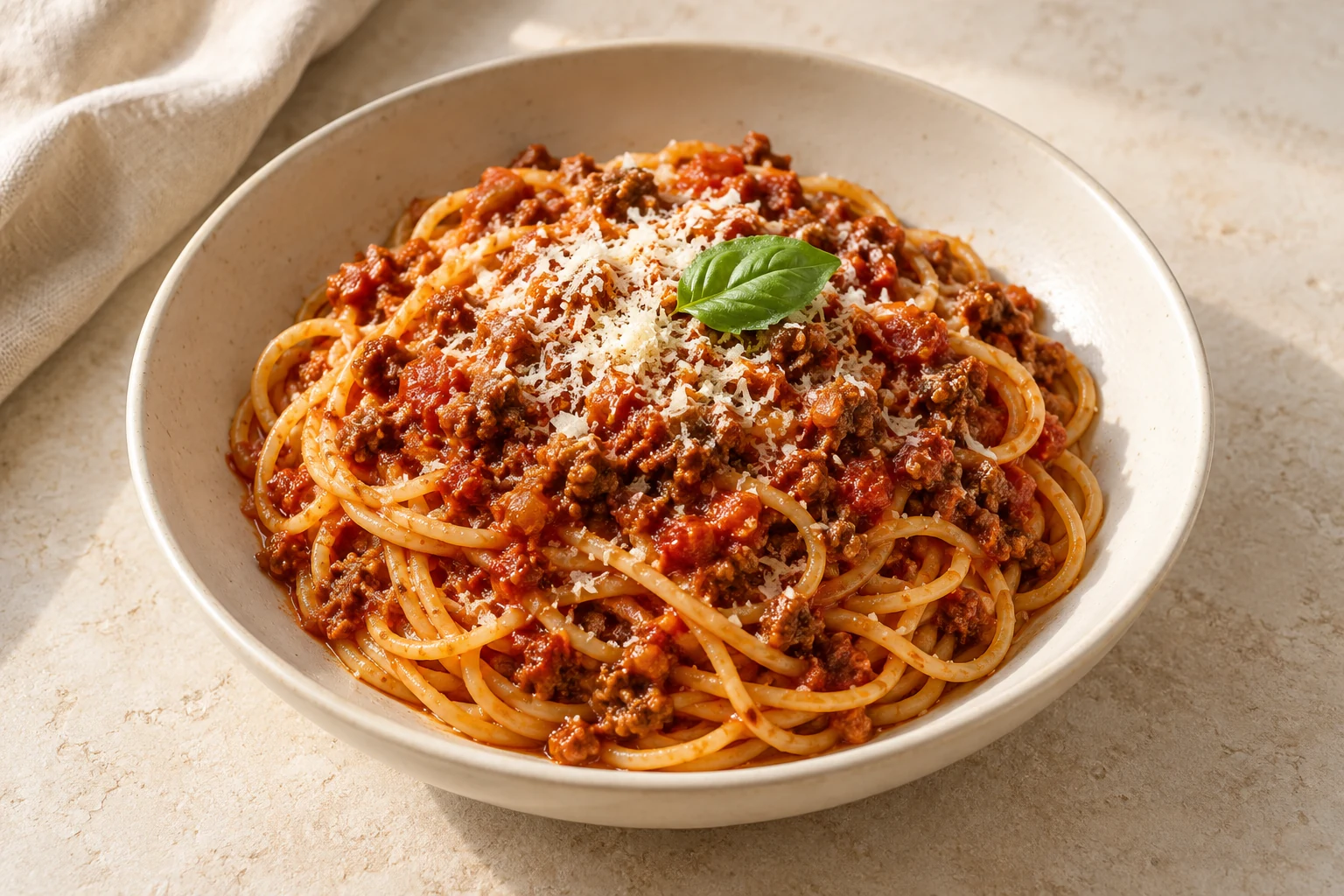
A gently simmered beef and tomato sauce wrapped around spaghetti, with sweet softened vegetables and a little milk for a rounded finish.
Save to your Saucey Space, or keep a bookmark on this device.
A NOTE FROM THE KITCHEN
Give the sauce a gentle simmer.
This is an Italian-inspired home version of spaghetti Bolognese, using canned tomatoes and a manageable stovetop simmer. It is not a claim to the traditional ragù of Bologna, which is commonly paired with wider egg pasta. Chop the vegetables finely so they soften into the meat sauce.
Ready to get started? The ingredients and steps are right below.
LET’S MAKE SOMETHING GOOD
Spaghetti Bolognese
Sample recipe awaiting kitchen testing. Timings are estimates.
The good part
Check off each step as you cook.
0 of 4 steps complete
BEHIND THE DISH · Bologna, Italy & kitchens abroad
Spaghetti BologneseBeyond the plate.
A familiar bowl of spaghetti carries a surprisingly complicated name. Its story joins Bologna’s meat-sauce tradition with the cookbooks, shopping habits, and home kitchens that gave Bolognese a wider life.
ORIGINS & EVOLUTION
A city’s sauce takes another shape.
In Bologna, ragù is closely associated with broad ribbons of egg tagliatelle. The sauce combines meat with finely chopped vegetables and patient cooking. A recipe deposited with the city’s Chamber of Commerce was updated in 2023, a reminder that even formally recorded traditions can be reconsidered.
Spaghetti with Bolognese sauce also has a documented past. A 1917 cookbook for American kitchens recommended its beef, pork, and vegetable sauce for macaroni or spaghetti. That particular recipe contained no tomatoes, so it records a connection between pasta and name without being identical to today’s tomato-rich supper.
CULTURAL IMPACT
The name travels farther than the recipe.
The international dish and Bologna’s local specialty sit alongside one another, each with its own expectations. A diner picturing spaghetti and abundant tomato sauce may be imagining something different from the slowly cooked ragù served with fresh egg pasta in Bologna.
Our version belongs to that adaptable home-cooking branch. It uses dried spaghetti, ground beef, canned tomatoes, garlic, and oregano, with a manageable simmer. Milk and finely chopped carrot, onion, and celery retain a connection to Bolognese sauce-making, while the proportions and timing are our own.
SOCIAL HISTORY
A wartime cookbook opens a kitchen door.
The 1917 cookbook was sold to help families of Italian soldiers during the First World War. Its introduction presented Italian household cooking as a source of practical economy for American readers. Recipes could carry charitable work and cultural exchange into the same kitchen.
That is a more concrete story than assigning the dish to one returning soldier or unnamed immigrant. Written recipes show cooks translating ingredients, pasta shapes, and household resources for new audiences. The bowl on our table continues that process of adaptation rather than reproducing a single historical meal.
What else sounds good?
There’s a little more inspiration in the kitchen.
Back to the recipes