
Italian · Main course · SAMPLE RECIPE
Saltimbocca alla romana
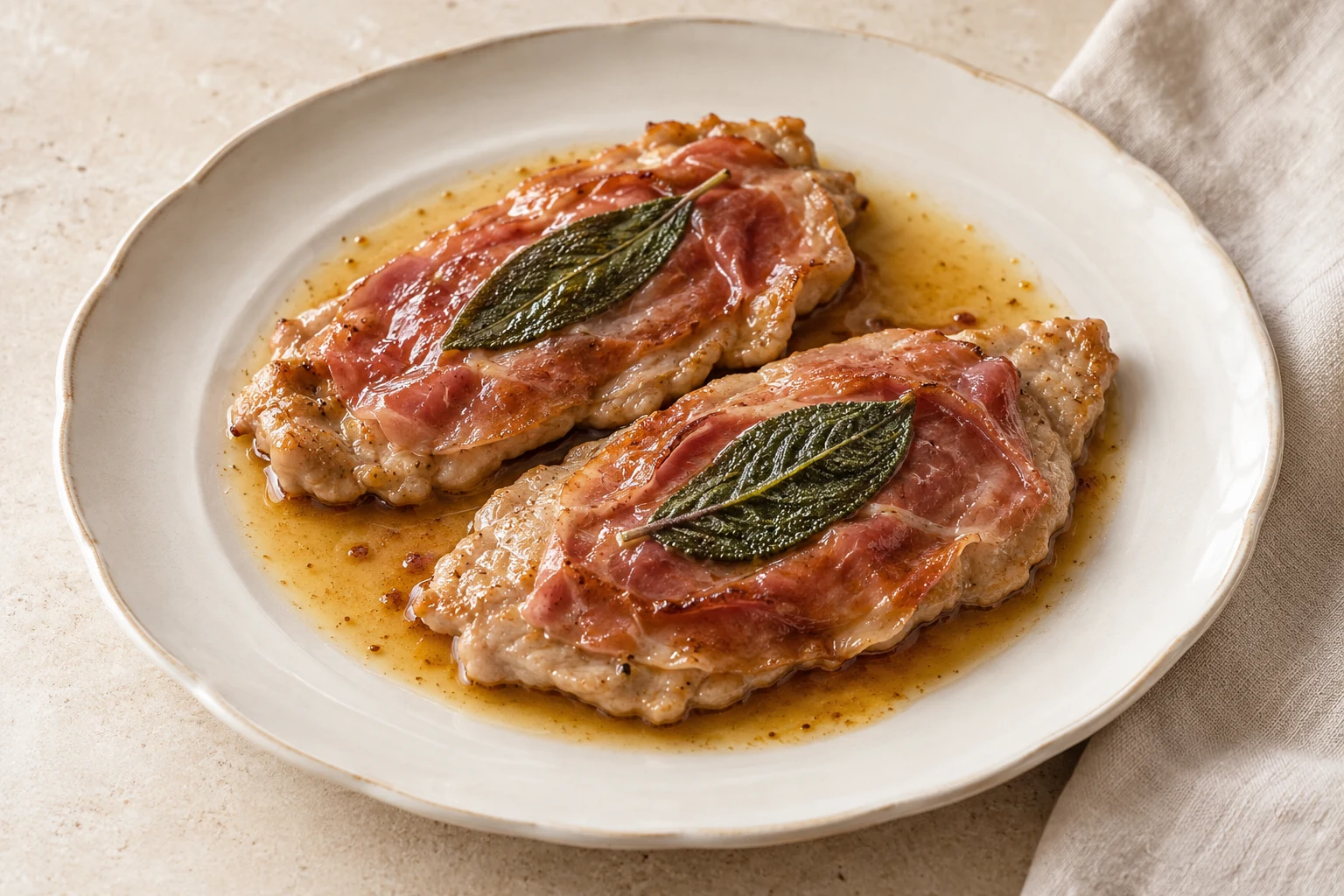
Thin veal cutlets wear prosciutto and sage, then meet a glossy butter pan sauce in this quick Roman-inspired main.
Save to your Saucey Space, or keep a bookmark on this device.
A NOTE FROM THE KITCHEN
Thin cutlets, a short pan sauce.
These flat cutlets pair veal, ready-to-eat prosciutto and sage. This home version uses low-sodium chicken stock instead of the wine found in many preparations. Prosciutto contributes plenty of salt, so season the finished sauce only after tasting.
Ready to get started? The ingredients and steps are right below.
LET’S MAKE SOMETHING GOOD
Saltimbocca alla romana
Sample recipe awaiting kitchen testing. Timings are estimates.
The good part
Check off each step as you cook.
0 of 4 steps complete
BEHIND THE DISH · Rome · Lazio
Saltimbocca alla romanaBeyond the plate.
Saltimbocca pairs thin veal, prosciutto and sage in a dish strongly associated with Rome. Its story moves between restaurant tables, printed recipes and adaptations that carry the combination beyond its familiar form.
ORIGINS & EVOLUTION
Roman identity, uncertain beginnings
Despite the name alla romana, accounts of an earlier connection to Brescia persist. The exact birthplace remains uncertain. What is clearer is the dish’s established place in Roman cooking by the late nineteenth century, when it appeared in the city’s restaurant culture.
Artusi’s recipe 222 describes saltimbocca tasted at a trattoria in Via di Campo Marzio. That concrete record is more useful than an unverified story about a single inventor.
CULTURAL IMPACT
A combination that travels
Saltimbocca has become recognizable through its small cutlets and contrasting ingredients: mild veal, cured ham and aromatic sage. Regional and modern variations may change the meat, ham or shape. The flat Roman form is one clear reference point within that larger family.
Restaurant cooks have also translated the idea into other ingredients. Chef Fortunato Nicotra developed a scallop version with speck, the smoked cured ham. Such adaptations show how a dish name can signal a flavor combination even when the central ingredient changes.
SOCIAL HISTORY
From restaurant technique to home supper
The trattoria account places saltimbocca in the history of eating out, while published methods carry its technique into home kitchens. Pounding meat thin, securing its topping and making a quick pan sauce are skills a cook can repeat without the equipment of a restaurant.
The work is concentrated just before serving: the cutlets need space in the pan and attention in successive batches. That helps explain their suitability for cooking to order, although it does not prove why the dish originated. Our stock-based sauce is a stated home adaptation to versions using wine.
What else sounds good?
There’s a little more inspiration in the kitchen.
Back to the recipes