
Chinese · Main course · SAMPLE RECIPE
Kung pao chicken
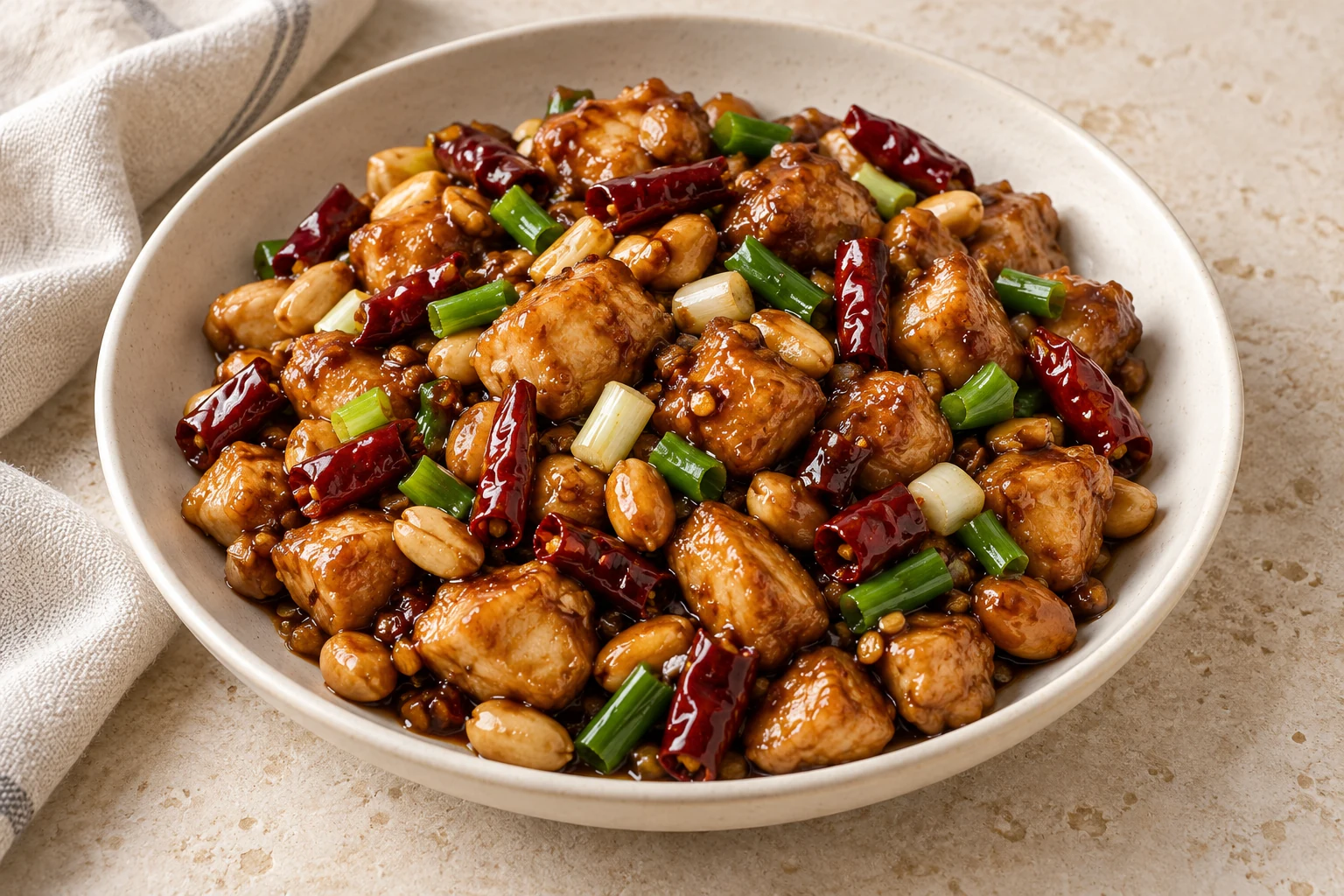
Quick-cooked chicken, crunchy peanuts, and a glossy tangy sauce with dried chiles and the optional tingle of Sichuan pepper.
Save to your Saucey Space, or keep a bookmark on this device.
A NOTE FROM THE KITCHEN
A Sichuan-inspired home stir-fry.
This version balances vinegar, soy sauce, and a little sugar with roasted peanuts. Whole dried chiles perfume the oil; their heat varies, so start with fewer if desired. Sichuan peppercorns add a citrusy tingling character, but the dish can be made without them.
Ready to get started? The ingredients and steps are right below.
LET’S MAKE SOMETHING GOOD
Kung pao chicken
Sample recipe awaiting kitchen testing. Timings are estimates.
The good part
Check off each step as you cook.
0 of 4 steps complete
BEHIND THE DISH · Sichuan, China & Chinese restaurants abroad
Kung pao chickenBeyond the plate.
Chicken, peanuts, dried chiles, and a bright glaze give kung pao chicken its distinctive balance. Behind that compact stir-fry are disputed origin stories, an official title, and a name that once became politically awkward.
ORIGINS & EVOLUTION
A governor’s title, several possible stories.
Gong bao, also written kung pao, is associated with Ding Baozhen, a nineteenth-century Qing official who governed Sichuan. The dish takes its name from his official title. Stories differ about how it entered his household and whether its earlier connections lie in Guizhou or elsewhere.
Those competing accounts are best left as possibilities. The dish’s connection with Sichuan is clear, but its history also reaches beyond a single provincial boundary. Following it through different places reveals how a regional specialty can develop through movement, adaptation, and later identification with a particular cuisine.
CULTURAL IMPACT
A small dish with an unusually wide reach.
Kung pao chicken has appeared in settings as different as Chinese state banquets and American fast-food restaurants. That range has made it an especially visible example of Chinese cooking abroad, even though individual versions can differ in heat, sweetness, vegetables, and the amount of sauce.
Our preparation takes a Sichuan-inspired approach: chicken pieces, peanuts, scallions, dried chiles, and a lightly sweet vinegar sauce. Sichuan pepper is optional here, so cooks can choose whether to include its characteristic tingle. This is a home adaptation, not a claim that every restaurant plate should taste the same.
SOCIAL HISTORY
Politics reaches the menu.
During the Cultural Revolution, the dish’s association with an imperial official made its name politically unwelcome. It circulated under more descriptive chicken-and-chile names before gong bao returned to favor. The episode shows how food names can carry social meanings beyond the ingredients in a bowl.
There is also a quieter story in the preparation itself. Small chicken pieces, short scallion lengths, and peanuts make a coordinated mouthful, while the nuts are added late to retain their texture. Our recipe preserves that attention to contrast while using a familiar skillet or wok and readily available chicken thighs.
What else sounds good?
There’s a little more inspiration in the kitchen.
Back to the recipes