
American · Dessert · SAMPLE RECIPE
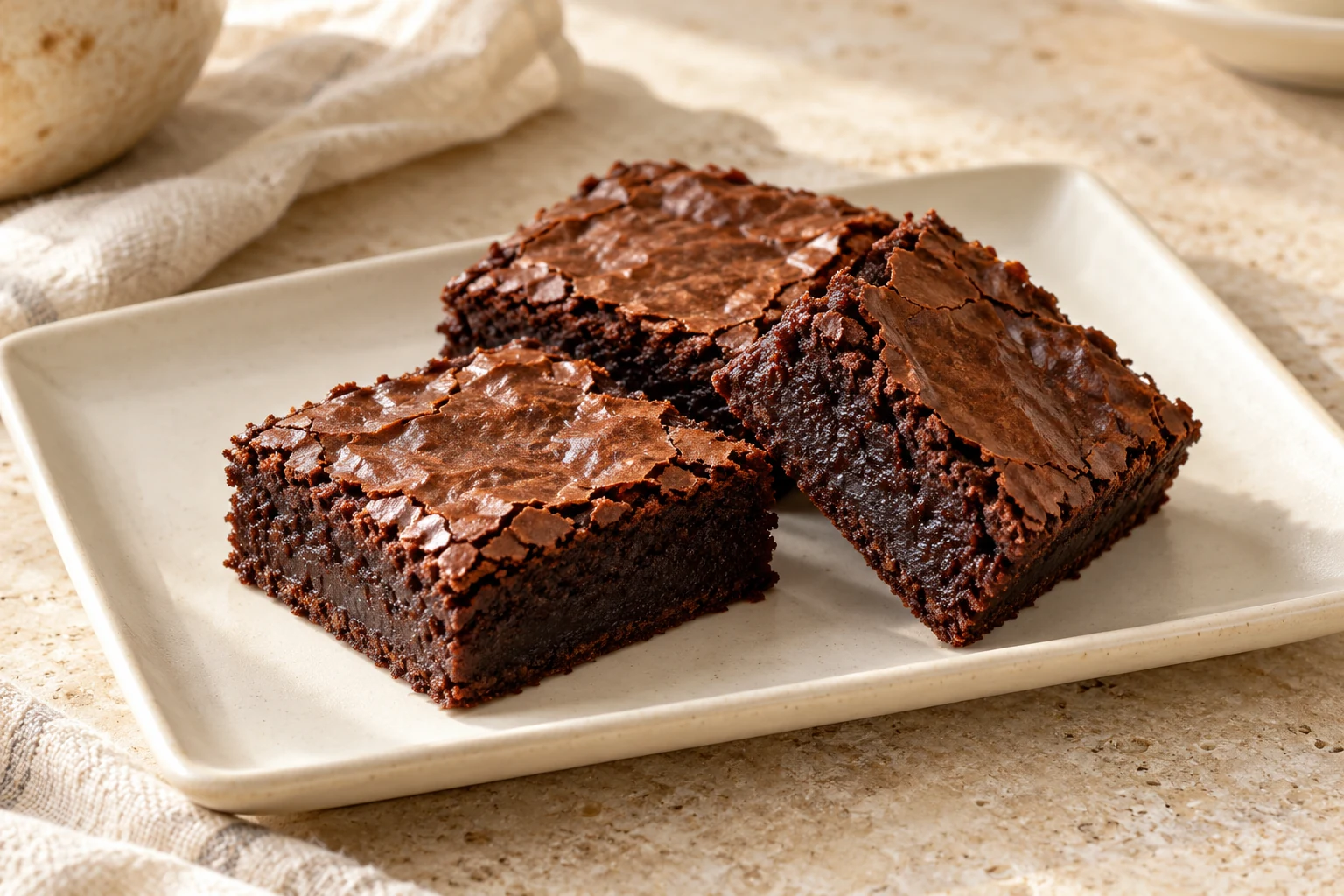
Fudgy chocolate brownies
Chocolate-rich brownies with a thin, crackly top and a dense, tender middle. Melted chocolate and cocoa work together in this simple one-pan bake.
Save to your Saucey Space, or keep a bookmark on this device.
A NOTE FROM THE KITCHEN
Fudgy still means fully baked.
Look for cooked, moist crumbs on the tester rather than liquid batter. The brownies become easier to cut as they cool. One 8-inch square pan makes 16 small, rich portions; there is no frosting or nut topping.
Ready to get started? The ingredients and steps are right below.
LET’S MAKE SOMETHING GOOD
Fudgy chocolate brownies
Sample recipe awaiting kitchen testing. Timings are estimates.
The good part
Check off each step as you cook.
0 of 4 steps complete
BEHIND THE DISH · United States
Fudgy chocolate browniesBeyond the plate.
The brownie sits comfortably between cake and cookie, with a history that is less tidy than its cut edges. Hotel kitchens, early cookbooks, and small collections of shared recipes all help explain its American identity.
ORIGINS & EVOLUTION
A name with several early meanings.
Chicago’s Palmer House traces its chocolate brownie to the 1893 World’s Columbian Exposition. In the hotel’s account, Bertha Palmer asked for a compact dessert that visitors could carry. Its walnut topping and apricot glaze distinguish that version from many plain brownies baked today.
That is an important origin claim, rather than proof that every modern brownie descends from one recipe. The name itself was still flexible: Fannie Farmer’s 1896 cookbook included small molasses cakes called brownies. A familiar word did not yet guarantee the chocolate square now expected.
CULTURAL IMPACT
A small square with many identities.
The Palmer House continued serving its distinctive brownie and made it part of the hotel’s public history. A dessert became a way for guests to encounter an institution’s past through something they could actually eat, rather than simply read about.
Other brownie traditions took a different direction. Butterscotch brownies appear in a 1973 collection assembled by staff of a university rare-books room. Chocolate intensity, toppings, and texture can change substantially while the brownie remains a recognizable, easily portioned kind of home baking.
SOCIAL HISTORY
Recipes travel through people, too.
The 1973 recipe was contributed by Philip Shelley, a professor of German and comparative literature, and his partner Robert Bauer. Its preservation offers a small, specific example of people sharing domestic tastes through a workplace community, alongside their professional lives.
Set beside the hotel’s exposition story, that modest staff collection shows two very different routes by which a dessert acquires a history. One belongs to a prominent public institution; the other records personal participation. Neither requires an invented tale about a cook accidentally forgetting an ingredient.
What else sounds good?
There’s a little more inspiration in the kitchen.
Back to the recipes