
French · Main course · SAMPLE RECIPE
French onion soup
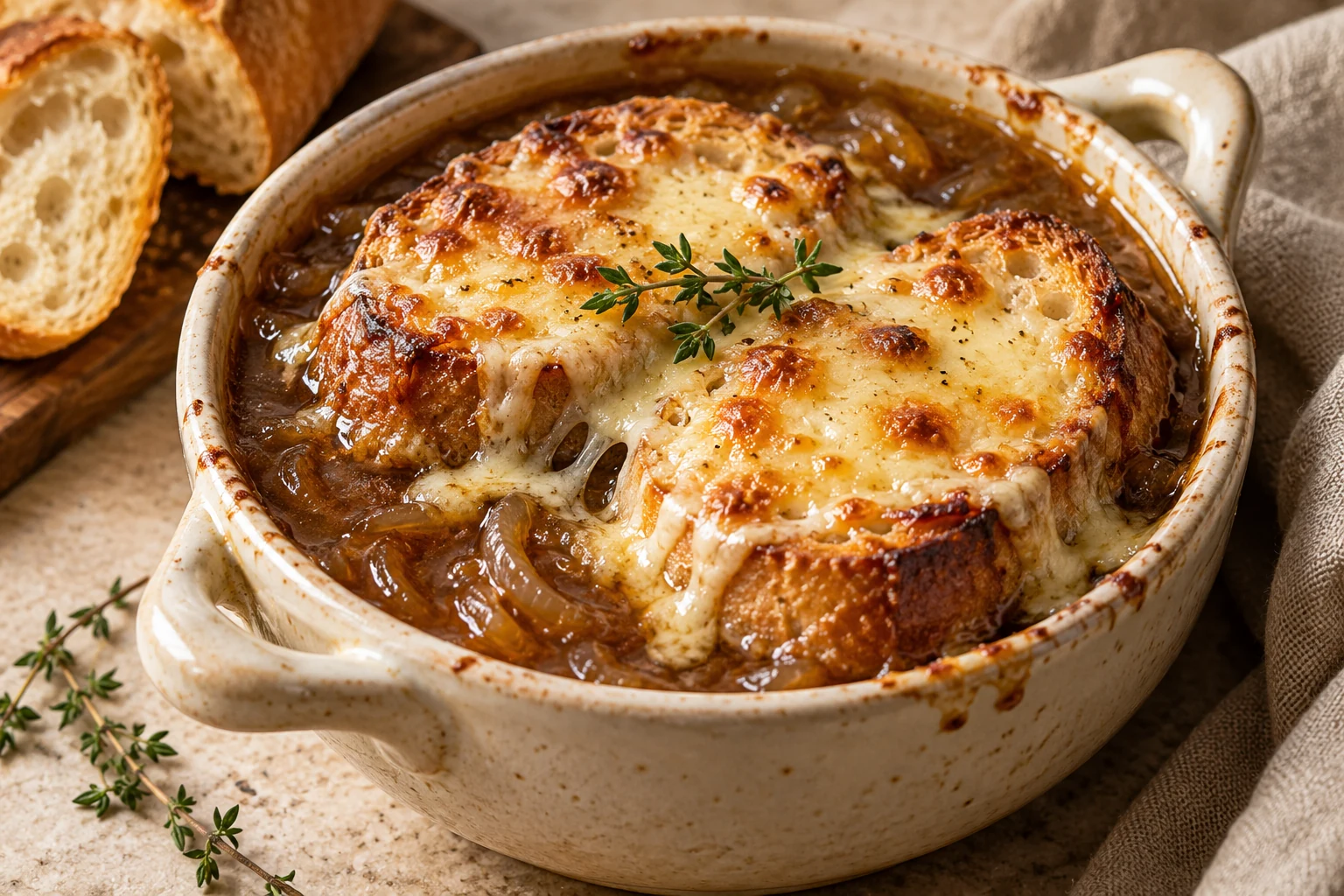
France’s comforting onion soup, with deeply caramelized onions and a bubbling cheese toast. A slow afternoon in a warm bowl.
Save to your Saucey Space, or keep a bookmark on this device.
A NOTE FROM THE KITCHEN
The onions set the pace.
The flavor comes from patient browning. Onions may need longer than the estimate if the pan is narrow or they release a lot of water. Stop when they are an even deep amber, before they turn bitter or black.
Ready to get started? The ingredients and steps are right below.
LET’S MAKE SOMETHING GOOD
French onion soup
Sample recipe awaiting kitchen testing. Timings are estimates.
The good part
Check off each step as you cook.
0 of 4 steps complete
BEHIND THE DISH · France, especially Paris
French onion soupBeyond the plate.
Beneath the bubbling cheese is a soup shaped by patient cooking and city life. French onion soup’s strongest associations lead to Parisian brasseries and the market district where people once ate around the clock.
ORIGINS & EVOLUTION
An older soup acquires a golden lid.
Onion soups have a longer history than the particular bowl now familiar internationally. The modern French version builds flavor by slowly browning onions, adding stock, and finishing with bread and melted cheese. That final gratin makes it distinct from a simple onion broth.
Stories that credit a hungry king with inventing the dish are better treated as legends than as a reliable starting point. A more useful history follows the soup into the restaurants around Les Halles, where the cheese-topped version became closely associated with the neighborhood.
CULTURAL IMPACT
A market neighborhood becomes a dining memory.
Les Halles developed over centuries into Paris’s central food market. Its nineteenth-century iron-and-glass pavilions housed a busy world of food trading, with restaurants and entertainment nearby. The market closed in 1969, but its name continued to carry powerful associations with eating in Paris.
Onion soup helps preserve that connection. A bowl described as a gratinée des Halles evokes the old market district even after its original commercial life has disappeared. A recipe can become a way of remembering a place, as well as something a restaurant serves.
SOCIAL HISTORY
A hot meal across the working night.
Au Pied de Cochon opened in 1947 with around-the-clock service that accommodated the market’s workers, sellers, and customers. Its onion soup became a signature. This gives the dish a concrete social setting: food service organized around the hours of people supplying a city.
The restaurant’s connection with late dining also links the soup to leisure after work. Our home version makes its own practical choices: beef stock supplies the broth, sherry vinegar adds sharpness without wine, and Gruyère melts over toast. Time spent browning the onions remains the essential investment.
What else sounds good?
There’s a little more inspiration in the kitchen.
Back to the recipes