
Italian · Main course · SAMPLE RECIPE
Roasted eggplant parmigiana
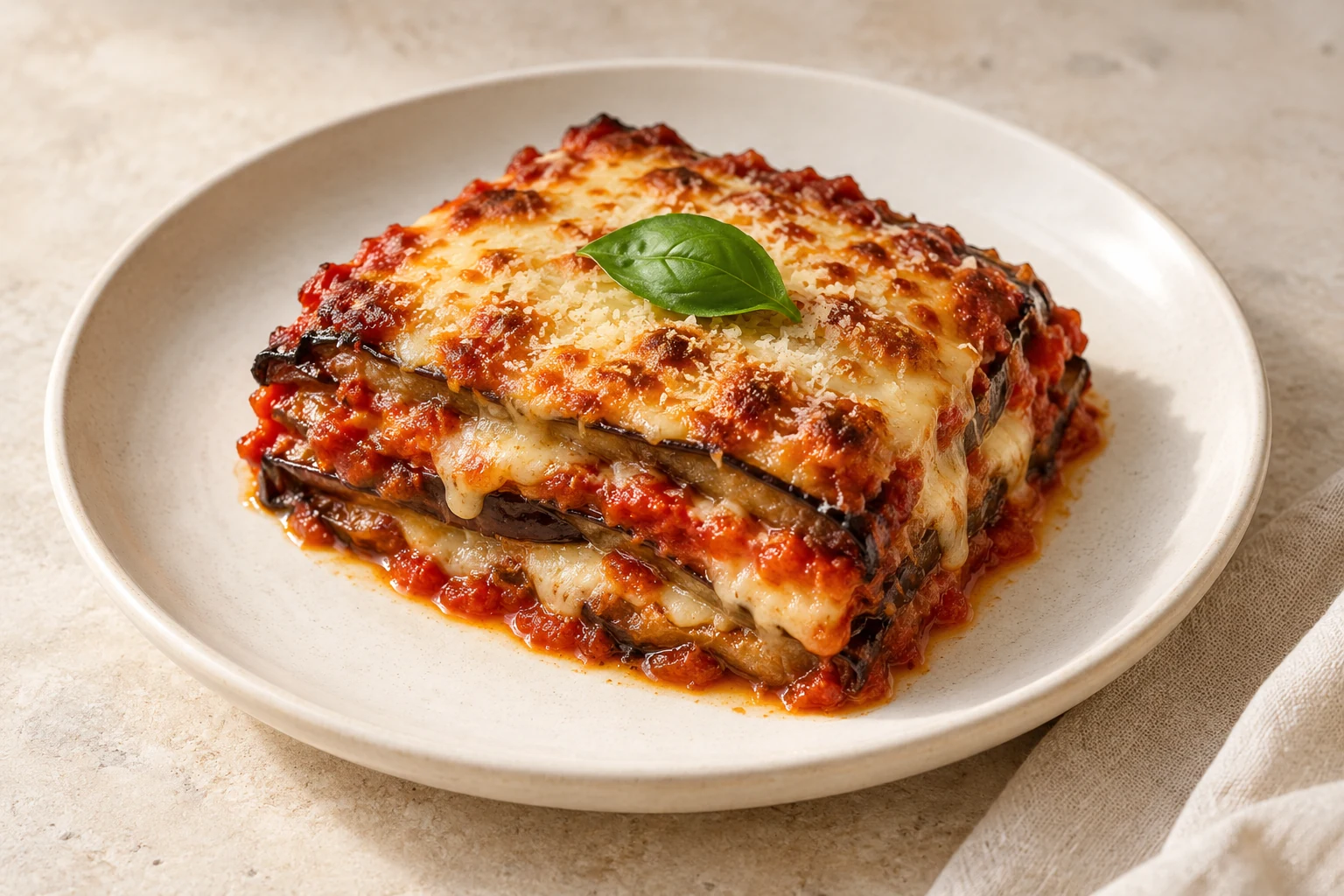
Tender roasted eggplant, a concentrated tomato sauce and two cheeses bake into soft layers with a golden, bubbling top.
Save to your Saucey Space, or keep a bookmark on this device.
A NOTE FROM THE KITCHEN
Roast first, then build the layers.
Many southern Italian versions begin with fried eggplant. Here the slices roast on sheet pans before meeting the sauce and cheese: an oven-friendly home adaptation with no breading. A thick sauce and well-drained mozzarella help the finished layers hold together.
Ready to get started? The ingredients and steps are right below.
LET’S MAKE SOMETHING GOOD
Roasted eggplant parmigiana
Sample recipe awaiting kitchen testing. Timings are estimates.
The good part
Check off each step as you cook.
0 of 4 steps complete
BEHIND THE DISH · Southern Italy · especially Campania and Sicily
Roasted eggplant parmigianaBeyond the plate.
Eggplant parmigiana brings vegetables, sauce and cheese together in layers, while its history brings together competing regional claims, family preferences and the movement of people beyond Italy.
ORIGINS & EVOLUTION
Layers before a settled origin story
Campania, Sicily and Parma all appear in arguments about the dish or its name. Explanations involving Parmesan cheese and Sicilian words for shutters circulate widely, but no single etymology settles where the modern eggplant preparation began.
Eighteenth-century cook Vincenzo Corrado described a layered vegetable preparation using zucchini. By the 1830s, Ippolito Cavalcanti recorded a recognizable eggplant version with cheese, basil and sauce. These written examples document an evolving family of preparations; they cannot identify the first household to cook one.
CULTURAL IMPACT
Regional pride, different layers
The differences are practical as well as symbolic. Cooks may fry eggplant plain or with a coating, choose mozzarella or other southern cheeses, and adjust the amount of sauce. Those choices help explain why a familiar name can produce quite different plates.
Parmigiana also appears in summer gatherings and Sunday meals, when eggplant, tomatoes and basil lend themselves to a generous shared dish. Preparing a tray for others gives those individual choices an audience: the family version becomes the version guests remember.
SOCIAL HISTORY
Migration changes the family recipe
Southern Italian migration carried parmigiana to the Americas and Australia. Italian-American cook Michele Becci describes growing up with her mother’s breaded, fried version, then encountering unbreaded preparations while visiting Sicily. Her experience illustrates how family memory and travel can reveal different branches of the same dish.
There is labor behind that comforting tray: cutting, cooking slices, making sauce and assembling layers. Roasting the eggplant here changes that workflow and avoids a frying stage. It is a practical adaptation, while the layers still keep vegetables at the center of the meal.
What else sounds good?
There’s a little more inspiration in the kitchen.
Back to the recipes