
American · Dessert · SAMPLE RECIPE
Chocolate chip cookies
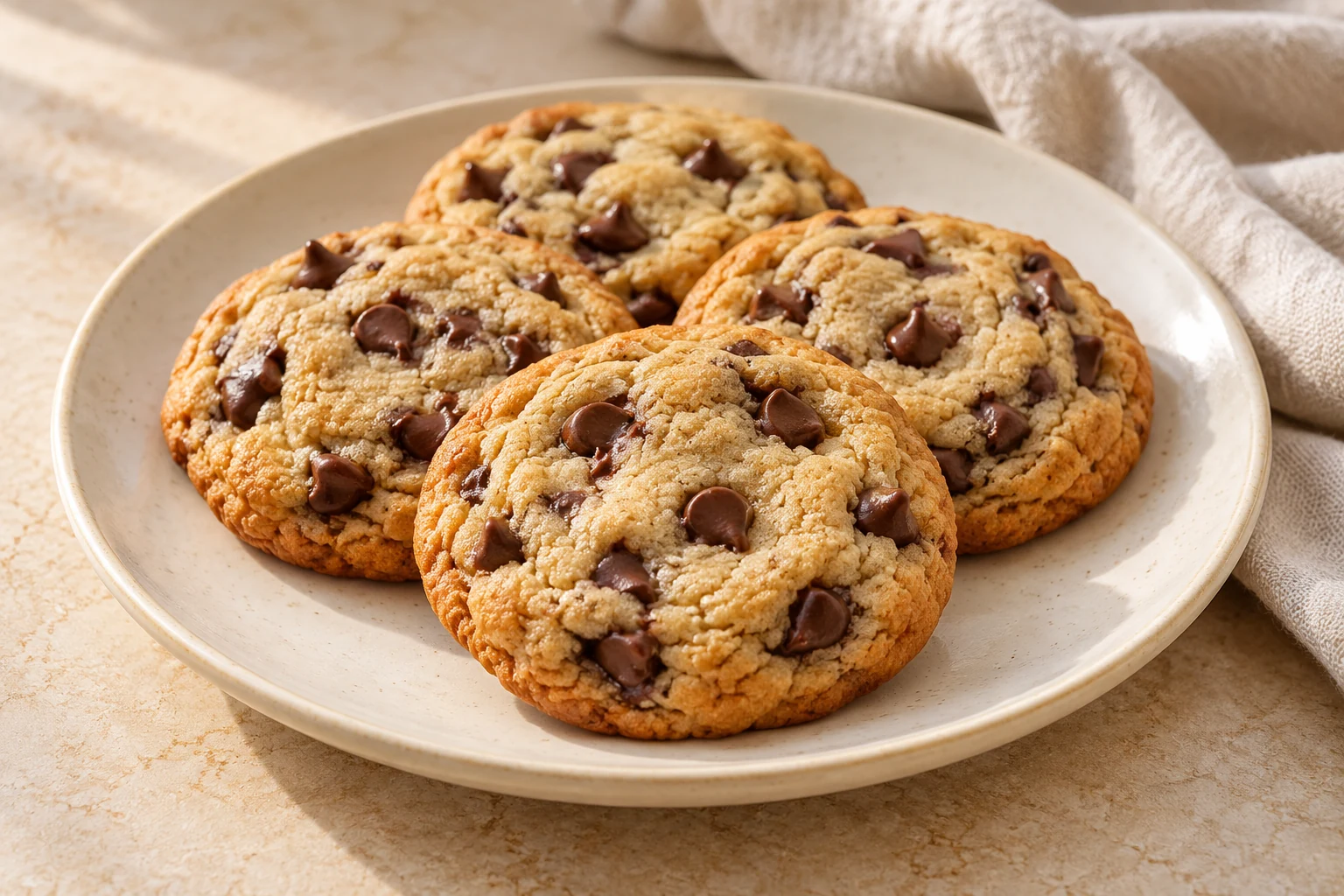
Buttery cookies with golden edges, soft centers, and plenty of chocolate chips. A short chill gives the dough time to firm up before it goes into the oven.
Save to your Saucey Space, or keep a bookmark on this device.
A NOTE FROM THE KITCHEN
A small scoop makes a good everyday cookie.
This batch makes about 24 cookies, each portioned from roughly 1½ tablespoons of dough. Brown sugar brings a little chew, while white sugar helps the edges crisp. One cookie is one serving.
Ready to get started? The ingredients and steps are right below.
LET’S MAKE SOMETHING GOOD
Chocolate chip cookies
Sample recipe awaiting kitchen testing. Timings are estimates.
The good part
Check off each step as you cook.
0 of 4 steps complete
BEHIND THE DISH · Massachusetts, United States
Chocolate chip cookiesBeyond the plate.
Chocolate chip cookies began as a restaurant specialty and became a household habit. Their story gives credit to a skilled cook while showing how cookbooks, advertising, and parcels sent from home helped a recipe travel.
ORIGINS & EVOLUTION
A deliberate new cookie.
Ruth Graves Wakefield ran the Toll House Inn in Whitman, Massachusetts, with her husband Kenneth. Trained in home economics, she developed the chocolate crunch cookie there. The recipe appeared in her 1938 cookbook, giving the familiar combination a firm place in the written record.
Popular stories describe a kitchen accident, but Wakefield later said she had intentionally worked on a new cookie. Early instructions called for chopping a semisweet chocolate bar into small pieces. Ready-made morsels would turn that extra task into a simple pour from a packet.
CULTURAL IMPACT
The recipe travels with the chocolate.
Newspapers, cookbook publicity, and a radio cooking program helped spread the cookies beyond the inn. In 1939, the recipe began appearing on chocolate packaging. The ingredient and its suggested use promoted one another, bringing a restaurant’s specialty into home kitchens.
That relationship helped establish a lasting baking pattern: a familiar recipe could be found on the very product needed to make it. The cookie became easy to recognize and easy to repeat, while individual bakers could still change its size, texture, or additions.
SOCIAL HISTORY
A package could carry a taste of home.
During the Second World War, advertisements encouraged families to send Toll House cookies to service members. A surviving 1943 advertisement connects the cookies explicitly with home. Such promotion helped the recipe circulate while attaching it to affection, distance, and the work of preparing a parcel.
Other advertisements presented successful cookie baking as evidence of a good hostess. These images reveal expectations placed on domestic cooks, as well as the appeal of an achievable treat. Better control of oven temperatures also helped expand the range of cookies baked in twentieth-century kitchens.
What else sounds good?
There’s a little more inspiration in the kitchen.
Back to the recipes