
Italian · Main course · SAMPLE RECIPE
Beef & ricotta lasagna
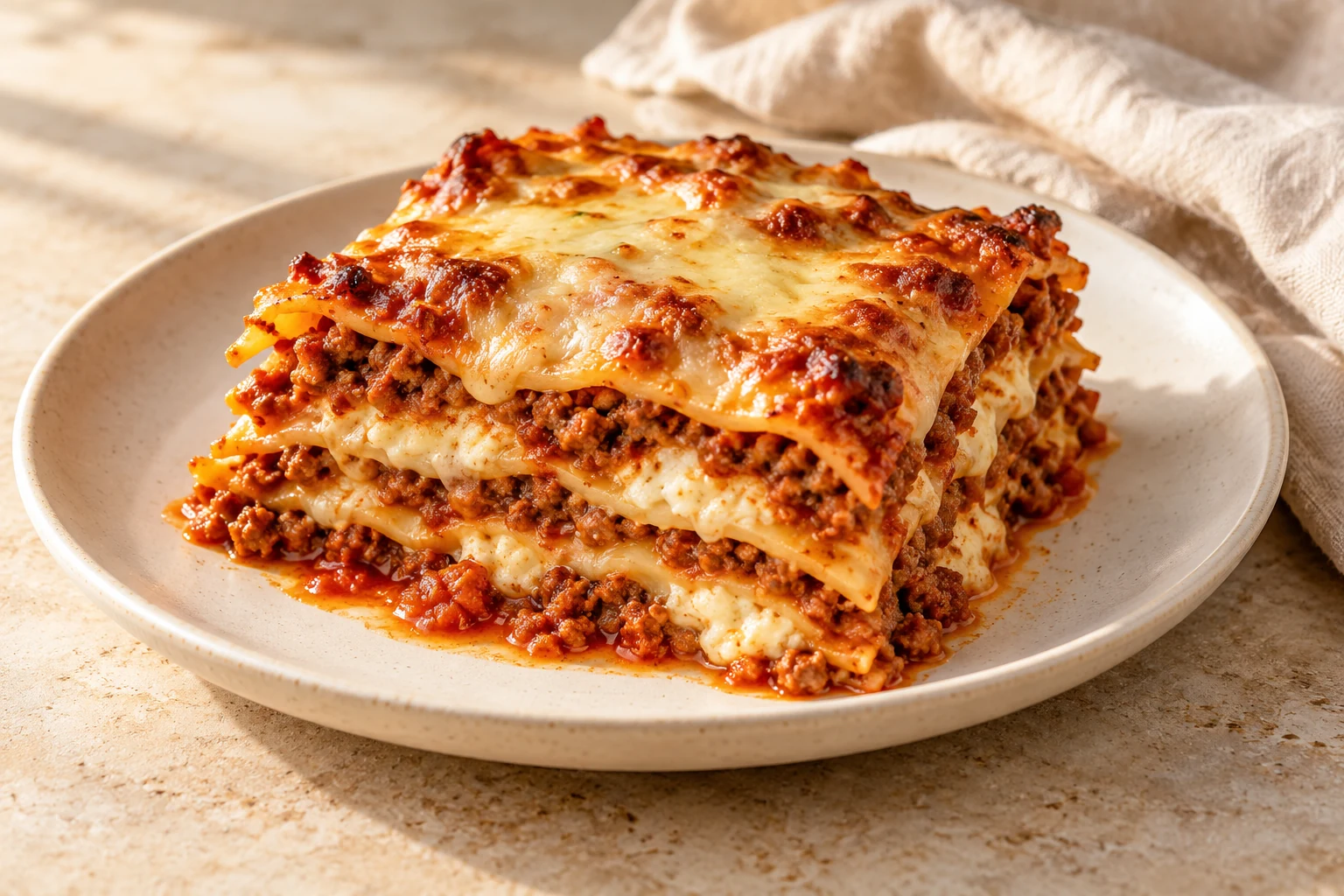
Tender pasta sheets layered with a beef and tomato sauce, creamy ricotta, and mozzarella, baked until the edges bubble.
Save to your Saucey Space, or keep a bookmark on this device.
A NOTE FROM THE KITCHEN
Rest before making the first cut.
This is an Italian-American style lasagna with ricotta rather than béchamel. Standard dried lasagna sheets are boiled before layering; oven-ready sheets absorb liquid differently and are not a direct substitution here. A short rest makes the layers easier to serve.
Ready to get started? The ingredients and steps are right below.
LET’S MAKE SOMETHING GOOD
Beef & ricotta lasagna
Sample recipe awaiting kitchen testing. Timings are estimates.
The good part
Check off each step as you cook.
0 of 5 steps complete
BEHIND THE DISH · Italy & Italian-American kitchens
Beef & ricotta lasagnaBeyond the plate.
Lasagna is a family of layered dishes as much as a single recipe. Our beef-and-ricotta version belongs to an Italian-American tradition, with relatives that tell different stories in Bologna and Naples.
ORIGINS & EVOLUTION
Many layers, more than one tradition.
Regional Italian lasagne differ in the pasta, sauces, and fillings placed between their layers. Bologna’s recorded green lasagne use spinach egg pasta, ragù, béchamel, and Parmigiano Reggiano. That combination offers a useful comparison with the ricotta and mozzarella familiar in many American kitchens.
Naples has a rich Carnival preparation involving ricotta, tomato sauce, and meatballs, with other additions varying by recipe. Ricotta therefore has Italian precedents as well as an Italian-American life. Our beef sauce and dried pasta sheets are a particular home adaptation within this larger collection of dishes.
CULTURAL IMPACT
A dish can represent a city or a family.
Bologna formally recorded a green-lasagne recipe in 2003, demonstrating how strongly a preparation can be connected to civic identity. In Naples, the association with Carnival gives a different kind of meaning: the layered dish becomes part of the annual rhythm of festive eating.
Italian-American lasagna has its own recognizable form. Cookbooks document layers of meat sauce, ricotta, mozzarella, and grated hard cheese. It carries an Italian connection without needing to duplicate Bologna’s béchamel version, and its familiar arrangement can remain recognizable even when households change the sauce or cheeses.
SOCIAL HISTORY
The work happens before the table fills.
A layered dish gathers several kinds of kitchen work into one pan: sauce-making, preparing pasta, mixing filling, and assembling. The preparation can be staged ahead, which helps explain its usefulness when feeding company. That is a practical reading of the method, rather than a claim that every family serves it on the same occasion.
Italian-American cooking instructions explicitly allow advance assembly and recommend resting the baked dish before cutting. Our version similarly asks for a pause after baking, giving the layers time to settle. The finished squares make the cook’s earlier work visible when the pan is finally brought to the table.
What else sounds good?
There’s a little more inspiration in the kitchen.
Back to the recipes