British · Dessert · SAMPLE RECIPE
Apple & oat crumble
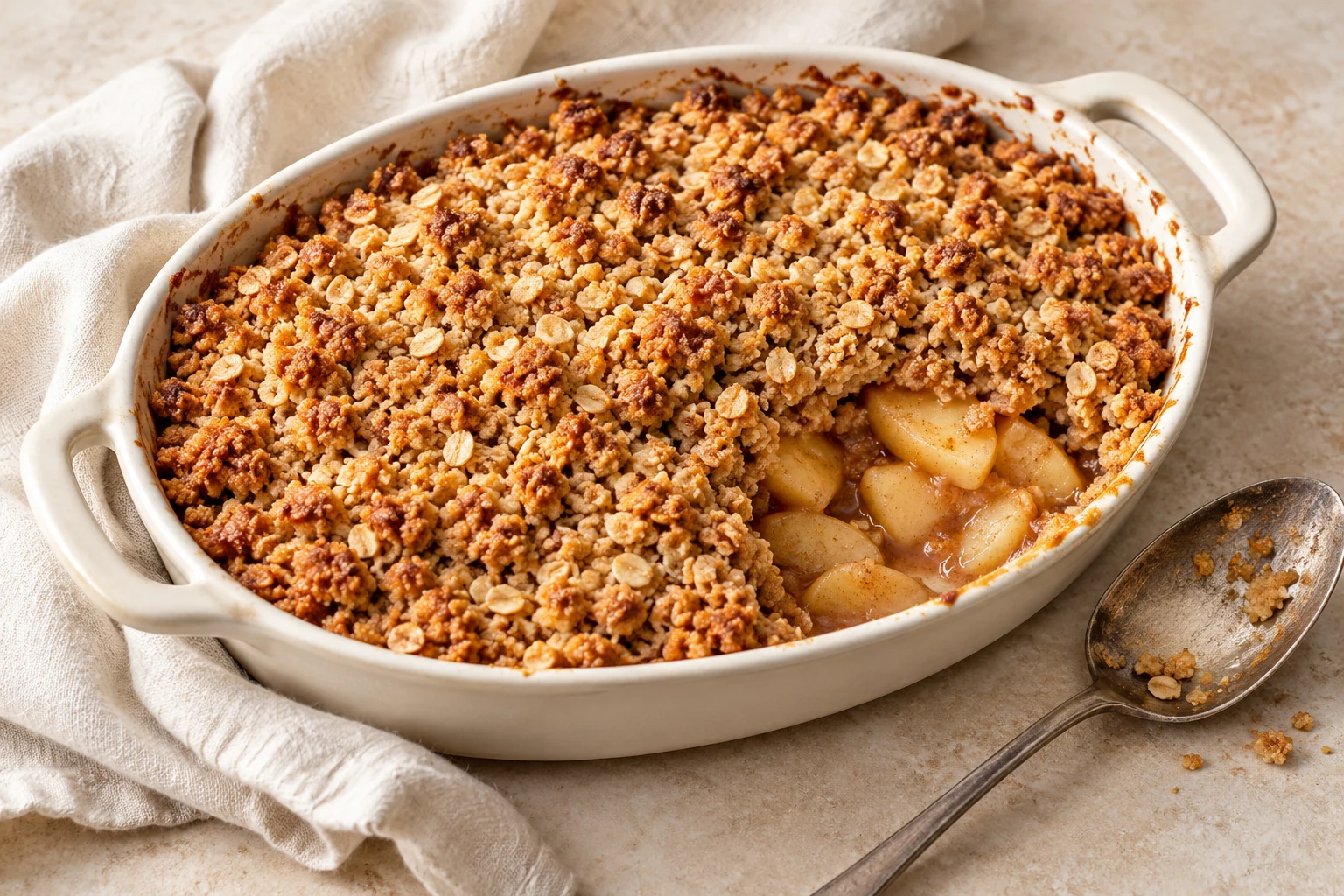
Warm cinnamon apples bubble beneath a buttery oat topping in this easy oven dessert. The fruit turns tender while the loose crumbs become crisp and golden.
Save to your Saucey Space, or keep a bookmark on this device.
A NOTE FROM THE KITCHEN
An oat-topped take on a familiar crumble.
This version adds rolled oats to the topping for a little more texture. Firm apples hold their shape as they bake; a mixture of tart and sweet fruit gives a rounded flavor without needing much added sugar.
Ready to get started? The ingredients and steps are right below.
LET’S MAKE SOMETHING GOOD
Apple & oat crumble
Sample recipe awaiting kitchen testing. Timings are estimates.
The good part
Check off each step as you cook.
0 of 4 steps complete
BEHIND THE DISH · Britain
Apple & oat crumbleBeyond the plate.
Apple crumble brings orchard fruit to the table with very little ceremony. Its history is best explored through household recipes, changing supplies, and the communities that keep local fruit varieties and familiar puddings in use.
ORIGINS & EVOLUTION
A familiar pudding, an uncertain birthday.
Crumble is often linked to wartime thrift, but that association does not establish one inventor or an exact beginning. British butter and sugar rationing began in 1940, creating a real setting for economical cooking. It is safer to distinguish that setting from a proven invention story.
A surviving fruit-crumble recipe from Abbot’s Hall in Suffolk gives firmer evidence of household practice. Dated to the middle of the twentieth century, it uses flour, margarine, and sugar over fruit. Its broad quantities suggest a flexible preparation rather than one tightly fixed formula.
CULTURAL IMPACT
The orchard becomes a pudding.
Apple crumble belongs to a much longer relationship between British cooking and cultivated fruit. The domesticated apple’s history reaches back to Central Asia; varieties moved across regions, and British growers developed and exchanged many forms, especially during the Victorian period.
A familiar dessert can give that variety a practical purpose. At Apple Day celebrations in Suffolk in 2021, historical recipes, fruit identification, and orchard knowledge appeared together. Crumble was one of the foods through which visitors could connect a named fruit with something to cook.
SOCIAL HISTORY
A recipe kept, then shared.
The Abbot’s Hall recipe was found in an attic. Its survival matters because everyday cooking often leaves small records: a brief set of quantities, an assumed technique, a note kept for later. Such fragments preserve domestic knowledge that may never appear in a celebrated cookbook.
At that Apple Day, people were invited to contribute family recipes to a shared display. A pudding’s history continues when someone remembers a method, writes it down, and passes it to another cook.
What else sounds good?
There’s a little more inspiration in the kitchen.
Back to the recipes