
Italian · Drinks · SAMPLE RECIPE
Aperol spritz
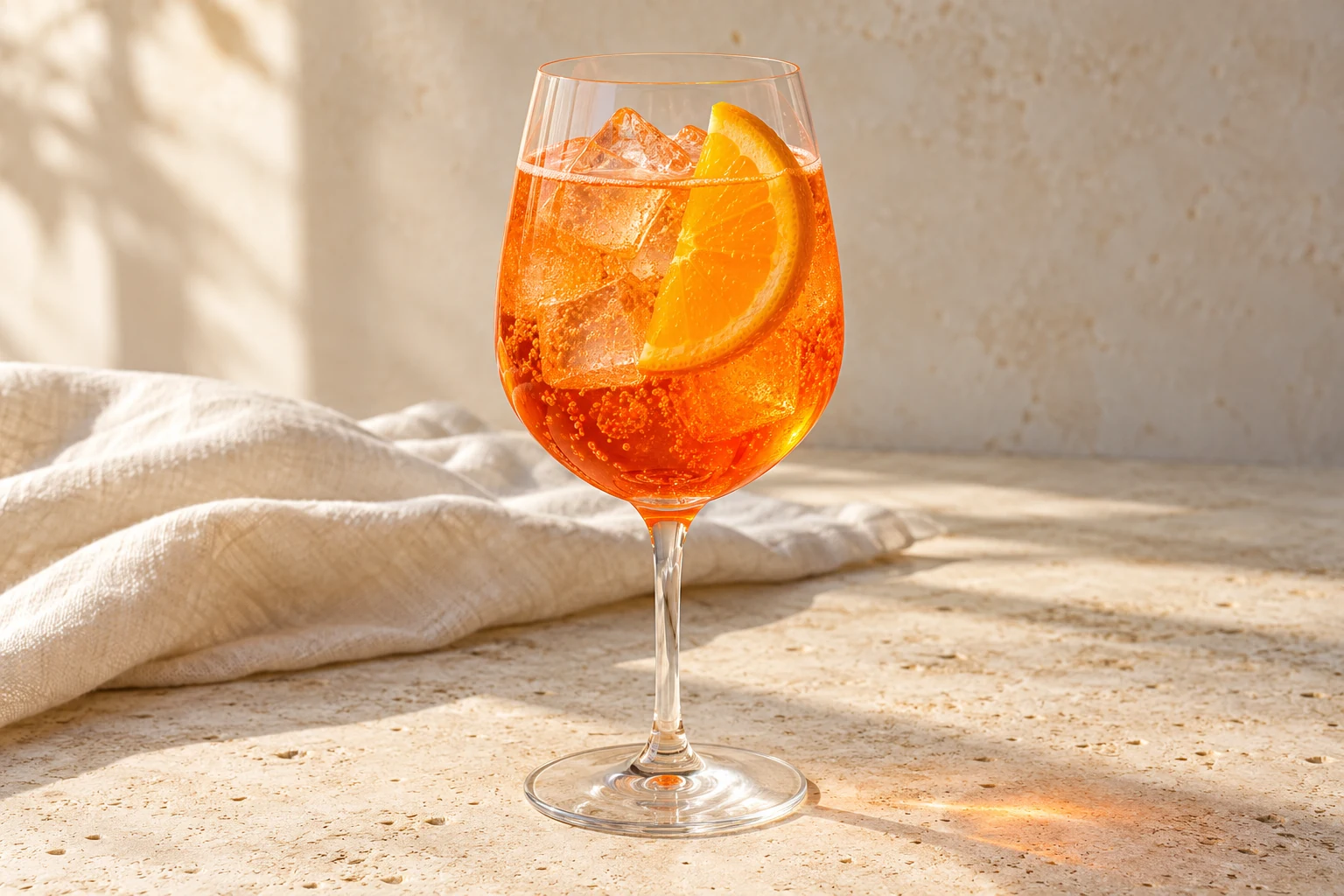
A bright orange, gently bitter spritz with chilled Prosecco, Aperol, and soda water, built over plenty of ice.
Save to your Saucey Space, or keep a bookmark on this device.
A NOTE FROM THE KITCHEN
Cold ingredients keep the bubbles lively.
Contains alcohol. This home spritz follows a three-to-two-to-one balance of Prosecco, Aperol, and soda. Start with refrigerated Prosecco and soda water.
Ready to get started? The ingredients and steps are right below.
LET’S MAKE SOMETHING GOOD
Aperol spritz
Sample recipe awaiting kitchen testing. Timings are estimates. Contains alcohol.
The good part
Check off each step as you cook.
0 of 3 steps complete
BEHIND THE DISH · Padua and the Veneto, Italy
Aperol spritzBeyond the plate.
An Aperol spritz belongs to a larger family of wine-based aperitifs. Its orange color is internationally recognizable, while its history connects to the cafés, squares, and gatherings of northeastern Italy.
ORIGINS & EVOLUTION
The liqueur came before the familiar mixture.
Luigi and Silvio Barbieri introduced Aperol in Padua in 1919, following several years of development. That date belongs to the aperitif itself. The familiar combination with wine and soda developed later; both the brand’s chronology and Padua’s tourism history place its popular formulation in the 1950s.
The broader spritz tradition is associated with diluting local wine with water. Accounts often connect that practice with Austrian soldiers in the Veneto, but they should not be mistaken for precise documentation of the modern orange cocktail. Wine, bubbles, and a bitter aperitif came together over time.
CULTURAL IMPACT
A regional drink becomes an international image.
Advertising helped carry Aperol beyond its original regional setting. Television promotion accompanied its postwar growth, while later campaigns developed a wider international audience. After its acquisition by Campari, the spritz became central to the brand’s presentation through advertising, music, and other lifestyle promotion.
Other established spritzes use Campari, Cynar, or Select. Their family resemblance lies in wine, a bitter element, and bubbles, while the choice of aperitif changes both color and balance. Aperol is one recognizable member of this wider tradition.
SOCIAL HISTORY
The setting belongs to the recipe’s story.
In Padua, spritz drinking is associated with the city’s squares, arcades, cafés, and small accompanying snacks. It is especially linked to aperitif time, though local practice also includes other moments of the day. The drink is therefore part of how people use public places, as well as something mixed behind a bar.
Venice places similar importance on the late-afternoon aperitivo, including meeting places shared by residents and visitors. These settings help explain why the spritz is often understood as an occasion. Our version keeps the preparation straightforward: chilled sparkling ingredients, plenty of ice, and an orange slice.
What else sounds good?
There’s a little more inspiration in the kitchen.
Back to the recipes